.svg)


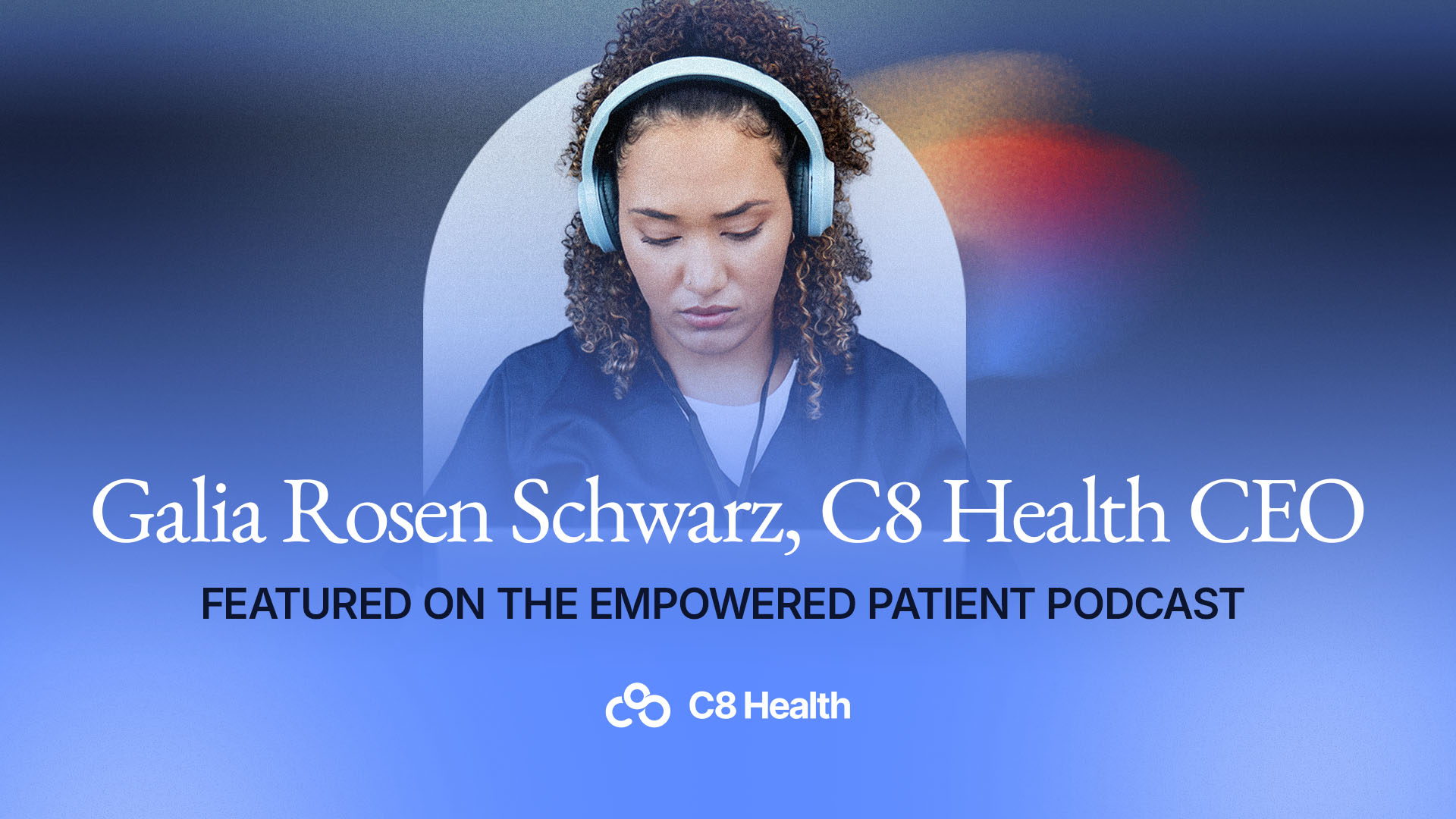
We're excited to share that our Co-Founder and CEO, Galia Rosen-Schwarz, recently joined Karen Jagoda on the Empowered Patient Podcast for a wide-ranging conversation about one of healthcare's most persistent and costly challenges: the gap between best practices and actual practice. Thank you to Karen and the Empowered Patient team for the thoughtful conversation and the platform to discuss how C8 Health is helping clinical teams bridge that gap — in real time, at the point of care.
The $345 billion care consistency problem
Hospitals create an enormous amount of clinical knowledge. They run clinical trials, license platforms like UpToDate and Open Evidence, and invest significant resources in building local protocols, guidelines, and educational content. The purpose of all of it is the same: ensure that standards of care are consistently met.
But as Galia explains in the podcast, there's a fundamental flaw in how most hospitals operate:
"I haven't met one hospital that knows how to take these best practices and turn them into actual practice — and this is what we allow them to do."
In clinical environments, legacy processes and infrastructure make it difficult to effectively implement best practices. The result is care inconsistency — a problem that costs the US healthcare system $345 billion annually. And it's not because clinicians don't care. It's because the systems designed to support them fail to deliver the right knowledge when it's needed most.
The root cause: Fragmented clinical knowledge
The episode digs into a challenge familiar to anyone working in a clinical environment: medical knowledge is scattered across disconnected systems. Protocols live in SharePoint folders. Guidelines are emailed as PDFs. Educational content is buried in learning management systems. Critical updates arrive as one of a dozen daily messages.
Research shows that if a clinician cannot locate the information they need within two minutes, they will rely on memory or intuition — increasing the risk of error. C8 Health was built precisely to solve this problem.
Solving knowledge activation at the point of care with AI
One of the most compelling moments in the podcast is when Galia illustrates what truly personalized clinical guidance can look like:
"We can create an experience where we say: 'Hi, Dr. X. Tomorrow you are scheduled for OR number eight. You have these four procedures. At 8:00 AM, you have a CABG procedure. These are the best practices of your hospital for this procedure. This is what changed since the last time you did this procedure. These are the people who are going to be with you in the OR.'"
This isn't a search tool. It's a proactive clinical partner — one that understands context and delivers exactly what a clinician needs, when they need it, without requiring them to go looking for it.
Knowledge that earns clinician trust
A major theme throughout the conversation is what it takes to build AI that clinicians actually trust and use. Unlike general-purpose AI tools, C8 Health's platform answers questions exclusively from each hospital's own vetted knowledge base. Panda AI, C8's built-in clinical AI assistant, is designed to distinguish between a policy, a protocol, an educational document, and a national guideline — and tailor its responses to each user's role and training level.
The results reflect this trust. C8 Health's hospital partners have seen average adoption rates exceeding 90% within six months of deployment — remarkable in an industry where 30–40% adoption is often considered a success.
From knowledge management to quality improvement
The episode also covers how C8 Health has evolved from a knowledge management platform into a full quality improvement infrastructure. By integrating with EHR systems and pulling real-time data, C8 can now show clinicians exactly where they stand on quality metrics — comparing individual performance against prior periods and departmental goals — and deliver those insights through the same interface they already use every day.
This shift from retrospective reporting to proactive, real-time feedback is at the heart of how C8 is helping hospitals not just access best practices, but actually implement them.
Listen to the full Empowered Patient episode for more insights on solving care inconsistency through AI-powered best practices implementation.