.svg)


Let Nurses be Nurses.
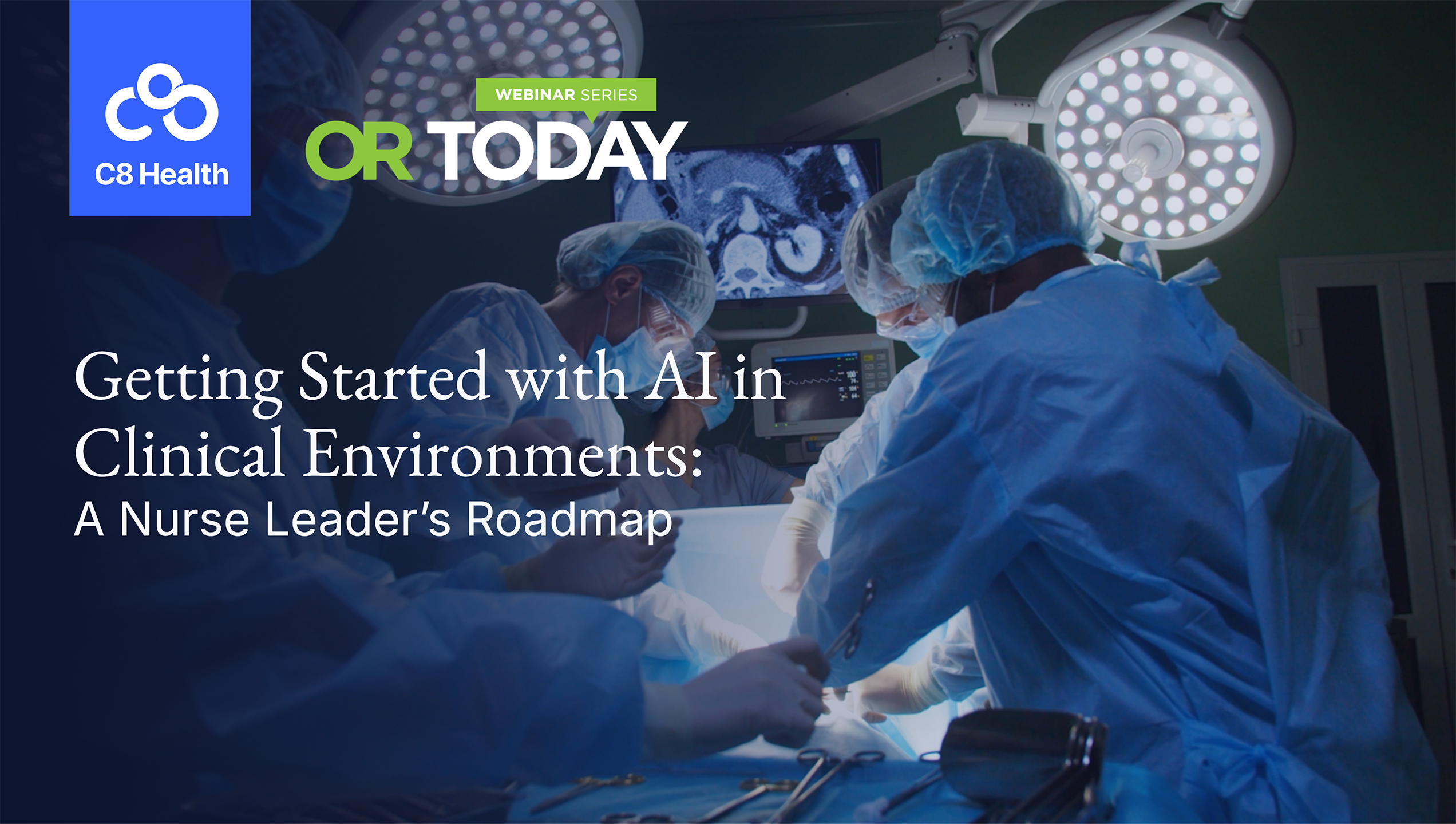
That was the common thread in our recent webinar with OR Today, Getting Started with AI in Clinical Environments: A Nurse Leader’s Roadmap. The conversation featured nursing leaders:
- Vangie Dennis, MSN, RN, CNOR, CMLSO, FAORN, FAAN, perioperative leader, former President of AORN, and Consultant for Perioperative Consultants, LLC
- Sicknee Daher, BSN, RN, Clinical Practice Director at Henry Ford Health
- Galia Fisher, MSN, RN, Vice President of Customer Success at C8 Health
They focused their discussion on the unique needs nurses face in the OR — and how AI can help address the actual problems in the room, not just the hypothetical ones.
Catch the webinar on-demand here
The Problems Nursing Teams Face Today
If you ask a perioperative nurse what slows their day down, the answer is rarely the surgery itself. It’s the documentation burdens — but not just the charting — it’s the hunt for the right answer at the right time, so that nurses can act in the patient’s best interest.
But for most nurses today, that isn’t where the push for AI has led. At least, not yet. Our panelists laid out the specific problems they’d like to see AI used to address:
- Helping newer nurses attain tenured nurse knowledge
- Documentation burdens
- Surgeon Preference Cards
Expertise lives in a few tenured heads
Perioperative practice has historically run on an apprenticeship model where tenured nurses who have the local knowledge pass their wisdom down to the next group. But with nursing shortages and changes to the workforce, Vangie set the scene where most nurses have fewer than five years of experience, and "see one, do one, teach one" has replaced the six months to a year of full hands-on learning that would be considered bare minimum — and somehow has become a luxury. This rushed pace has become the standard, but at the cost of vital knowledge new nurses need to succeed.
And the answers those new nurses need are often scattered. Sicknee pointed to pre-anesthesia testing, where nurses must search several parts of the chart to confirm whether a patient is ready for surgery. Add antibiotic timing in pre-op and complex perioperative glucose management across the whole continuum, and nurses are hunting for more than they should have to. With every search, nurses must leave their workflows to hunt the answer down, taking them away from their patients.
"Put the right information in front of the nurse at the right point of time within the work that they're doing, rather than expecting them to stop, look for it and then make a decision." - Sicknee Daher, BSN, RN, Clinical Practice Director at Henry Ford Health
Float staff and traveling nurses hit the same wall. The experienced nurses who know a room's workarounds are rarely close by for others to call on, and experienced nurses shouldn’t be used as personal training manuals. Vangie sees a way to capture that expertise, validate it, and keep it current, so that "a tenured nurse can be turned into a distributed mentor without burning out." Preceptors, she said, were tired of onboarding the same way, again and again.
Documentation pulls nurses away from the patients they should be serving.
Asked which single problem she would point AI at tomorrow, Sicknee chose documentation. It sounds simple because it is simple. Every requirement makes sense alone. Together they pull nurses away from the patient.
"I would like AI to reduce that repetitive charting, surface the information that the nurse actually needs to act on, and give that time back to our patient care." - Sicknee Daher, BSN, RN, Clinical Practice Director at Henry Ford Health
The goal is to make the right documentation easier and more meaningful, not to hold nurses less accountable or risk irresponsible charting. Documentation requirements exist for a reason, but fulfilling them in 2026 shouldn’t be this hard.
Preference cards: the bane of every nurse’s existence?
Then there are surgeon preference cards, which Vangie called "the bane of my existence." Keeping them updated feels pointless, when preferences change the very next day. And Sicknee agreed, updating preference cards is a workflow nurses would happily leave behind.
There's good news. C8 Health is designed to take the upkeep off your nurses. Surgeon preference cards live alongside your other standards, and updates reach staff at the point of care. Talk to an expert about how today.
What can nurses realistically hand off to AI?
What are the workflows nurses can actually leave behind? When the workflows don't make sense, or are too repetetitive, that's when technology should step in.
"Handoff to technology...when the task is repetitive, cognitively draining." - Vangie Dennis, MSN, RN, CNOR, CMLSO, FAORN, FAAN, perioperative leader, former President of AORN, and Consultant for Perioperative Consultants, LLC
Inventory counts, tray tracking, supply usage logs — and those surgeon preference cards. As Vangie said, she would like to see nurses “being a nurse and not counting widgets.” Vangie recounted a time when relocating a tray took 30 minutes, because someone had moved it without logging the information.
But what isn’t on the AI plate matters too. Clinical judgement should always stay with the clinician.
"AI doesn't replace our expert nurses. It amplifies them." - Vangie Dennis, MSN, RN, CNOR, CMLSO, FAORN, FAAN, perioperative leader, former President of AORN, and Consultant for Perioperative Consultants, LLC
Don’t forget to measure the impact.
Vangie also made the case for measuring the change expected, and realized (or not) with the AI solution. One heart team spent a week of perfusionist time, at roughly $125 an hour, assembling a single report. The AI program she wanted to bring in would have cost about $200 a case to prepare the same report, netting the organization $4800. Reducing the cost of almost anything by 96% is about as strong an ROI as a solution can hope for.
Where AI Can Help Nurses Right Away
Both leaders were candid when discussing the technology market. In general, the market has not caught up. Vangie described widgets that piggyback on the EHR, with nothing that wraps around the full scope of perioperative services. Sicknee said her team is hungry for the right solution — but that they currently don’t have one in place for their nursing teams.
Galia brought the gap down to a single question a nurse might ask on a Saturday night. Is a type and screen still valid after a day and a half in the pre-op space? Three weeks after onboarding, nobody is paging through a PDF to find out.
"I want to get an answer that surfaces my locally vetted practice and not ask Google." - Galia Fisher, MSN, RN, Vice President of Customer Success at C8 Health
And Galia notes that AI "still doesn't replace the critical decision-making that a nurse gets to make."
A successful solution fits the workflows nurses already have.
Any solution you bring into your organization must avoid becoming just another login. Galia described C8 Health as aiming to be "one place where many systems combine," working as an enhancement layer on top of the systems your team is already using.
You can’t just install, implement, and assume success. Real-world surveys must prove that the solution isn’t actually adding to your nursing teams’ burdens.
With C8 Health, customer results back this up. At MetroHealth, 94% of clinicians consult C8 Health before ERAS cases, and MetroHealth’s anesthesia department took ERAS compliance from 65% to 88% in just five months. Read the MetroHealth story.
Evaluating AI Solutions & Putting Nursing Leaders in the Room
When it comes to bringing an AI solution to nursing practice, there are critical non-negotiables that any solution must meet.
- Start with a clearly defined clinical and operational problem.
- Involve nurses in design and evaluation.
- Build into the tools they already use.
- Measure whether it is used and whether it changes the work.
“I also feel like we need to understand what the upkeep of this tool looks like. Who owns the content? How is the information kept current? How are concerns escalated when it's not operating the way we wanted it to? And what happens when we identify it's no longer working? - Sicknee Daher
But even before that, Vangie noted the most important rule of all.
"AI cannot safely integrate without clinical validation from the nurses who live that workflow." - Vangie Dennis, MSN, RN, CNOR, CMLSO, FAORN, FAAN, perioperative leader, former President of AORN, and Consultant for Perioperative Consultants, LLC
And nursing leaders must not wait to be asked to join the discussion, they need to claim a seat at the table on their own. Lead with the problems your team is living with, not technology for technology’s sake.
Today’s nursing shortage demands action. New nurses are out on the floor today, doing their best to learn one shift at a time from whomever is available; tenured nurses are already feeling the burden and burning out. Your nursing teams need solutions today, so they can operate better tomorrow.
The standards exist. But do your teams know how to access them when it counts? AI can’t replace clinical judgement. It can alleviate the burdens preventing your teams from being able to exercise it.
"Let's not say our technology is here to replace us."- Vangie Dennis, MSN, RN, CNOR, CMLSO, FAORN, FAAN, perioperative leader, former President of AORN, and Consultant for Perioperative Consultants, LLC
Watch the full webinar here. And then book your demo with C8 Health here.