.svg)


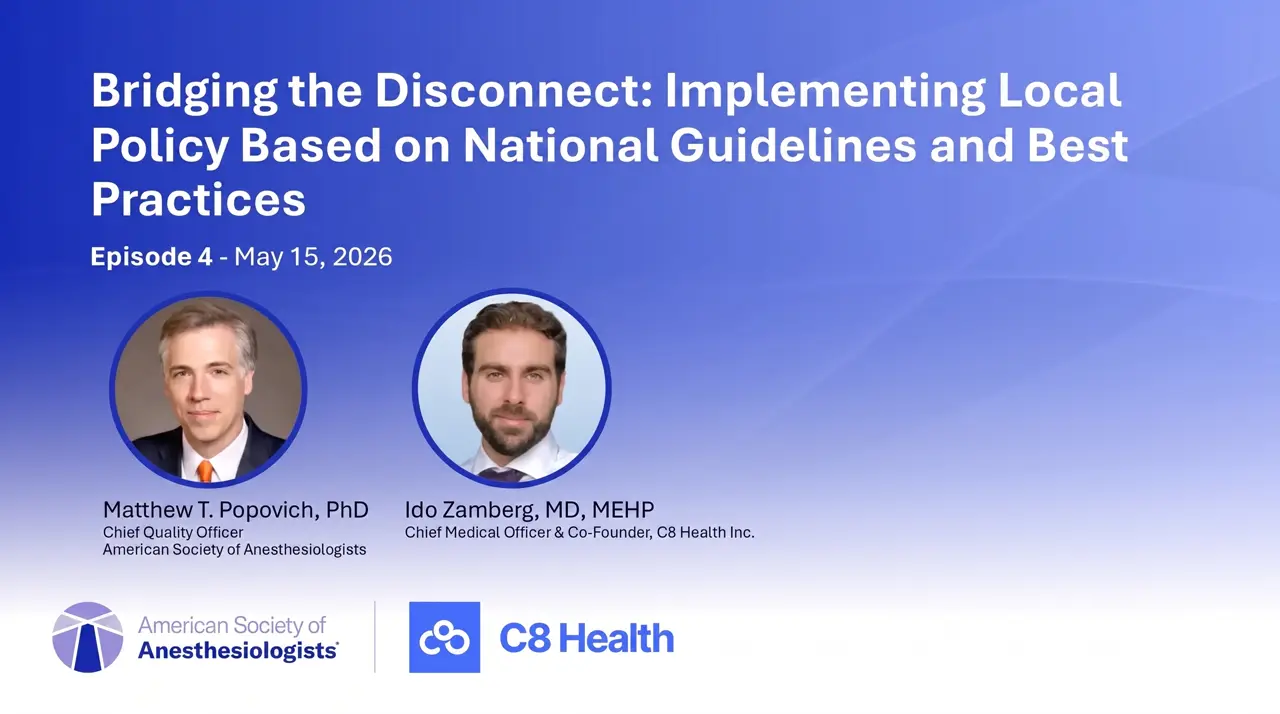
“Bridging the Disconnect” is a collaborative, interview-based webinar series produced by the American Society of Anesthesiologists and C8 Health. Hosted by Matthew T. Popovich, PhD, Chief Quality Officer of the American Society of Anesthesiologists, the series runs semi-weekly from July to August 2026 with a special guest offering fresh insights with each edition.
You don’t need a background in technology to understand that healthcare has a knowledge management problem, but it certainly helps. Anesthesiologist, computer scientist, and C8 Health co-founder Dr. Ido Zamberg spent 14 years in the tech industry before and during medical school. When he started his residency, he was surprised to find out how siloed evidence-based protocols were — even when departments worked together to develop those protocols.
“Each service line might have been eight to 15 different systems where this information can be found,” he recalled in the fourth episode of “Bridging the Disconnect,” a collaborative webseries from the American Society of Anesthesiologists (ASA) and C8 Health. Dr. Zamberg knew hospitals needed a better way to close the gap between policy and practice.
“Seven different protocols”
As an OB anesthesiology resident, Dr. Zamberg realized “There’s not really a sharing of information” beyond every clinician’s immediate needs. He found that information was siloed between departments, spread across a number of formats, and often duplicated or contradictory. “Seven different protocols for atrial fibrillation,” he gave as an example.
His background in technology made him realize that information was not being disseminated properly throughout the hospital. Enter C8 Health, a “unified platform where they can find answers to any clinical, administrative, operational, or educational questions that they might have on a day-to-day basis.”
He shared a story from his own experience about how this scenario plays out in practice. As the anesthesiologist on call in the OB ward, he suspected that a patient had a placental infection and recommended antibiotics. However, they didn’t present with a fever, and the OB/GYN stated that “We don’t give antibiotics if they don’t have a fever.”
In the past, that may have led to a dispute or wasted time searching through SharePoint and emails to find the policy in question. In this case, however, Dr. Zamberg pulled up the C8 app on his phone and showed the OB/GYN that a lack of fever shouldn’t prevent them from using antibiotics.
“The conversation just stopped there,” he said. With a standard policy based on evidence right in front of them, the doctor prescribed antibiotics. Two hours later, they got confirmation that the patient did indeed have a placental infection.
“These guidelines, when they are shared, can just make the conversation less about art or about opinions” and more about “actual evidence and practice and standardized care,” Dr. Zamberg explained.
How AI is transforming healthcare
In 2025, C8 partnered with the ASA to bring the society’s guidelines, standards, and statements into a more readable, actionable, and accessible format. According to Matthew T. Popovich, PhD, Chief Quality Officer at the ASA and host of “Bridging the Disconnect,” “Companies like C8 help anesthesiologists take those documents off the shelf and really make them more accessible.”
C8’s “best practices implementation” is made possible by advances in technology, particularly artificial intelligence (AI) and large language models (LLMs). Dr. Zamberg listed the ways that technology helps clinicians put best practices into daily action:
EMR: The advance of electronic medical records (EMR) gives hospitals large digital databases instead of paper charting.
- Data extraction: “There are a lot of frameworks to actually extract this data and calculate actual compliance to best practices, to quality standards, something we didn’t have just a few years ago,” Dr. Zamberg said.
- Mobile access: Mobile apps like C8 ensure that information can live anywhere in the workflow and be pushed contextually at any time — meaning real-time access is in your clinician’s pocket.
- AI: As MetroHealth’s Dr. Luis Tollinche said in the first episode of “Bridging the Disconnect,” simply consolidating data isn’t enough. AI is what allows healthcare systems to “take all this data and… generate insights that are actually relevant,” as Dr. Zamberg put it.
- LLMs: When you’re looking for specific information, you don’t want a 30-page PDF — you want an answer. When using an LLM-based platform like C8 Health, you can ask a question just as you would talk to your colleague and receive the specific data you’re looking for.
- Quality Improvement (QI): According to Dr. Zamberg, “Healthcare is not like other industries. People are not really pushed to be quantified of the performance of their work compared to other industries.” With the right tools, however, hospitals can track compliance and KPIs, accelerating QI projects and automating quality interventions at scale.
From 17 years to 10 minutes
According to a 2023 paper, it takes 17 years for medical evidence to change hospital practice. Dr. Zamberg wants to reduce that time to 10 minutes. “It’s not science fiction,” he said. “It’s very feasible and it’s very exciting.”
He hopes that in the future, there will be a more symbiotic relationship between national recommendations and local practice. He envisions an “almost autonomous” system in which groups like the ASA create a new guideline and tools like C8 Health can immediately benchmark how local practices are complying with that national recommendation. The key to making it work, he said, is workflow integration; imagine updates in real time, pushed directly to you without even having to look for it.
That’s how C8 Health has improved quality of care and protocol compliance for over 150 of the leading healthcare systems across the United States. As the first AI platform to put hospital best practices, operational knowledge, and quality data at clinicians’ fingertips, C8 accelerates Quality Improvement, doubling quality of care and dramatically increasing staff satisfaction. Learn more about the leading clinical performance platform here.
You can watch the full interview in the video at the top of this page. C8 Health would like to thank Dr. Ido Zamberg, Matthew T. Popovich, and the American Society of Anesthesiologists for their valuable time and perspective. You can learn more about the ASA at https://www.asahq.org.