.svg)


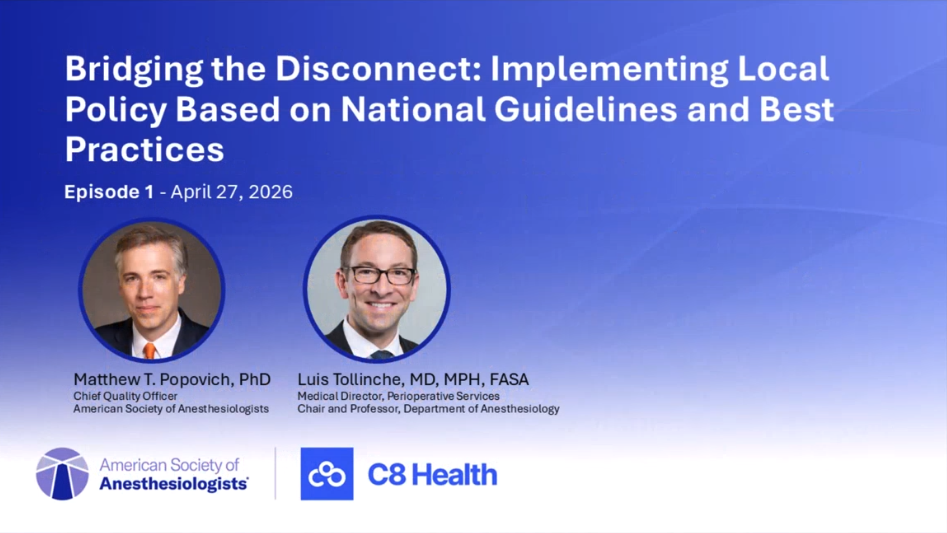
"Bridging the Disconnect” is a four-part interview series collaboratively produced by the American Society of Anesthesiologists and C8 Health. Hosted by Matthew T. Popovich, PhD, Chief Quality Officer of the American Society of Anesthesiologists, the series runs semi-weekly from July to August 2026 with a special guest offering fresh insights with each edition.
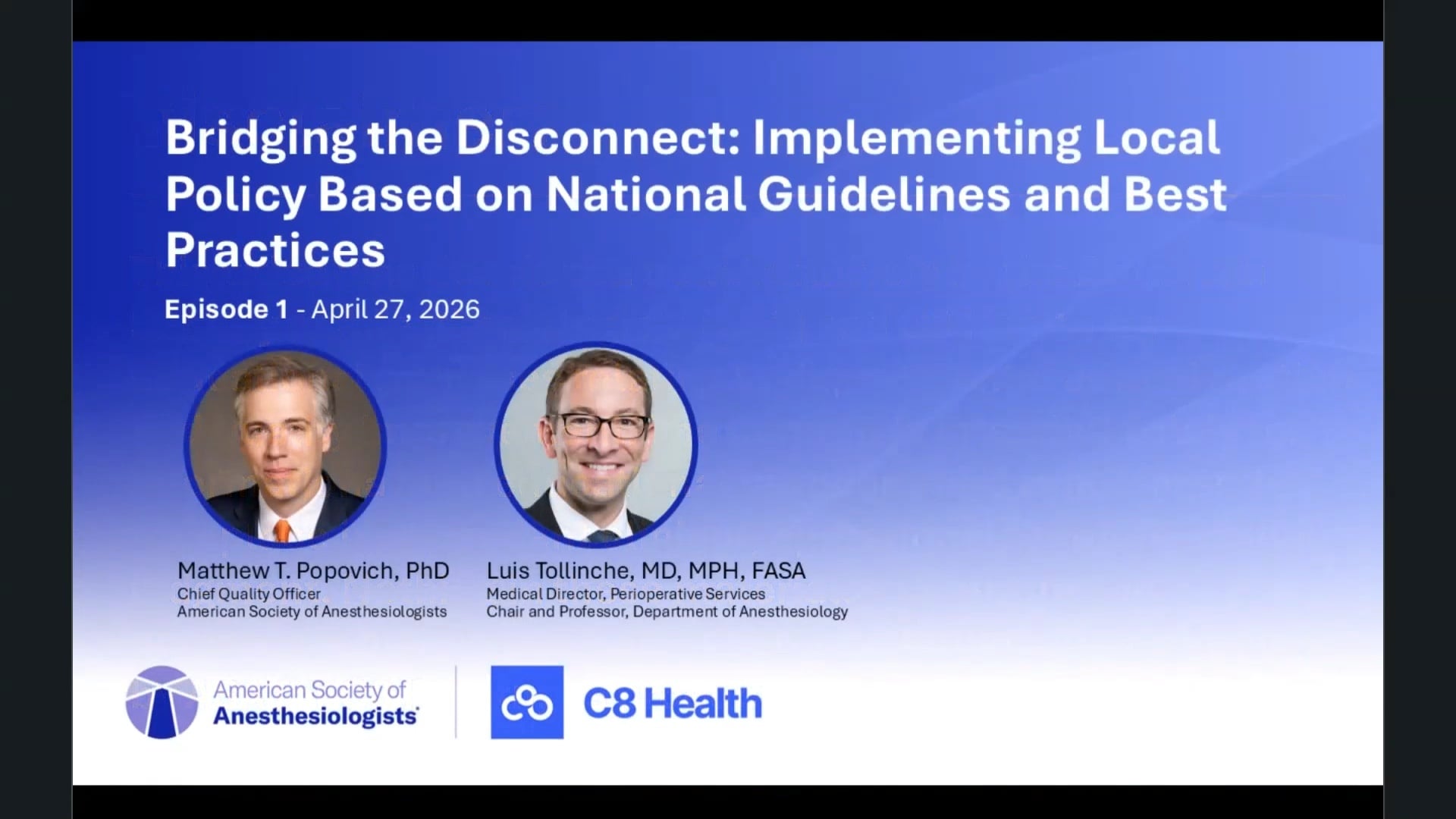
The American Society of Anesthesiologists (ASA) publishes new guidelines, statements, and policy positions every year. However, according to ASA Chief Quality Officer Matthew T. Popovich, PhD, many facilities struggle to communicate and implement these critical updates locally. As a result, healthcare systems fall behind on best practices, compliance, and improvement initiatives. So how can clinical leaders at these facilities ensure that the most up-to-date data is always within reach for care teams?
To answer this question, Dr. Popovich spoke to Luis Tollinche, MD, MPH, FASA. Dr. Tollinche is the Medical Director of Perioperative Services at MetroHealth, an Ohio-based healthcare facility that boasts a sprawling team of over 600 doctors, 1,700 nurses, and 8,000 dedicated professionals. Under Dr. Tollinche’s leadership, MetroHealth’s anesthesiology department is made up of over 120 staffers, including anesthetists, residents, techs, and administrative support. As one might expect, distributing protocol updates to a department of that size — let alone the wider clinical team — was a considerable challenge.
“I just didn’t know”
According to Dr. Tollinche, MetroHealth’s “well-intentioned but fragmented ecosystem” was a constant source of friction for his team. With data spread across SharePoint, department folders, PDFs on cloud drives, and email, clinicians defaulted to the information that was freshest in their memories or easiest to access.
When asking members of his team why they hadn’t referred to the most recent information in their courses of care, Dr. Tollinche often heard “I just wasn’t aware of the protocol” or “I just didn’t know.” “We had strong clinical expertise, but the system wasn’t reinforcing consistency,” he said. As a result, “education became reactive” — meaning changes occurred only after adverse reactions or negative outcomes.
The gap between evidence-based protocols and real-time clinical practice inspired MetroHealth to move toward a “centralized clinical knowledge management approach using the C8 Health platform.” Dr. Tollinche’s goal was to reduce the “cognitive and logistical friction” plaguing MetroHealth’s clinicians.
A shift in knowledge interaction
Dr. Tollinche noted that consolidating the many sources of truth across MetroHealth into a single shared playbook was a necessary first step, but “not sufficient on its own.” In many cases, he said, organizations who consolidate their data fail to see meaningful adoption because “the underlying problem” hasn’t been resolved. Using C8 Health, Dr. Tollinche saw a meaningful shift in how clinicians actually interact with that knowledge as a natural part of their workflows. The results: a fivefold increase in clinicians finding it easy to locate information and a 21% increase in clinicians reporting that knowledge resources contributed to quality of care.
“We’ve given a lot of thought to try to understand why that happened,” Dr. Tollinche explained. He narrowed it down to three critical factors:
- Shifting perspectives: Moving from a “document-based mindset” to a “decision-support mindset” changed the way clinicians thought about the hospital’s knowledge base. Instead of “Where is the document?”, the question became “How does the clinician get the right answer at the point of decision?”
- Trust is key: Once clinicians realized that their information was consistently current, locally adapted, and aligned with their standards, with no need to check multiple sources, it became easier to trust their own database.
- Governance matters: Content ownership was clarified, update cycles were formalized, and MetroHealth enforced visible accountability for maintaining accuracy. “That matters more than people sometimes assume,” Dr. Tollinche explained.
Speaking leadership’s language
Overhauling one department’s data management system is challenging enough. Convincing additional departments and stakeholders is an even bigger conundrum. As Dr. Popovich pointed out, “anesthesiologists don’t work in a vacuum,” so how did the knowledge management overhaul impact their work with other teams and specialties?
Dr. Tollinche believes it’s all about convincing leadership that the investment — both time and financial — will deliver a return. Stakeholder groups “often speak slightly different languages,” so start with shared operational goals and expect to have different conversations with administrators and frontline clinicians. The first step, he says, is “measuring process” — for example, “What percentage of end-stage renal disease patients had a potassium check?”
Once you’ve improved outcomes in your own department, the conversation with the C-suite changes because “You’re not just talking about a guideline, you’re demonstrating improved OR throughput.” Fewer cancellations and delays, better utilization of time, reduced downstream costs from avoiding complications — this is the language that leadership understands.
You can watch the full interview in the video at the top of this page. C8 Health would like to thank Dr. Luis Tollinche, Dr. Matthew T. Popovich, and the American Society of Anesthesiologists for their valuable time and perspective. You can learn more about the ASA at https://www.asahq.org.